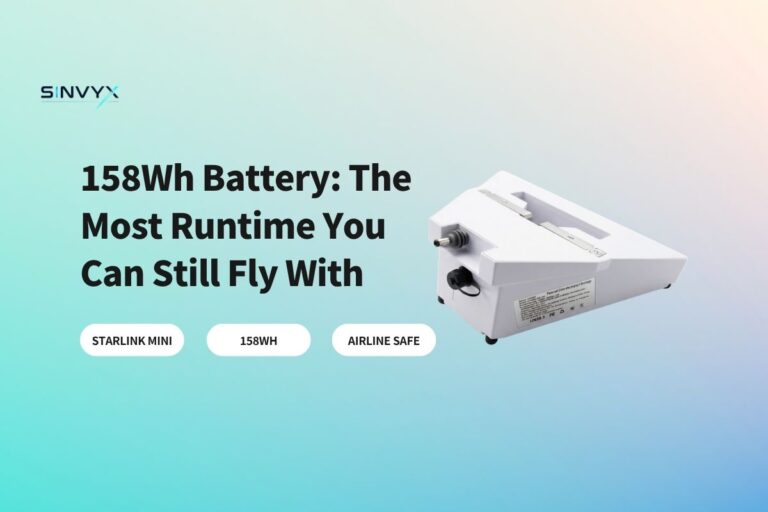
Four capacities, same housing, same IP65 rating, same direct 15–21V output for Starlink Mini. The difference is runtime and whether you can take it on a plane. Here’s how to pick.
Quick Pick
- Flying light? → 99Wh. Carry-on, no approval, 3–5 hours. Done.
- Flying but need a full workday? → 158Wh. 5–7 hours, carry-on with airline approval.
- Staying on the ground and need all-day power? → 180Wh. 6–9 hours, no airline option.
- Maximum runtime or emergency backup? → 200Wh. 7–10 hours, the most we make.
If that answers your question, contact us for pricing. If you want the details, keep reading.
Full Comparison Table
| 99Wh | 158Wh | 180Wh | 200Wh | |
|---|---|---|---|---|
| Capacity | 5.5Ah / 99Wh | 8.8Ah / 158Wh | 10Ah / 180Wh | 11Ah / 200Wh |
| Runtime | 3–5 hr | 5–7 hr | 6–9 hr | 7–10 hr |
| Weight | 1.7 lb (0.79 kg) | 2.42 lb (1.1 kg) | 2.42 lb (1.1 kg) | 2.42 lb (1.1 kg) |
| Airline | ✅ No approval | ✅ With approval | ❌ Not permitted | ❌ Not permitted |
| Cell brand | Samsung / LG | EVE | Samsung / LG | Samsung / LG |
| Charge time | ~3 hr | ~5 hr | ~6 hr | ~6.5 hr |
| Output | 15–21V | 15–21V | 15–21V | 15–21V |
| Waterproof | IP65 | IP65 | IP65 | IP65 |
| Working temp | -20°C to 60°C | -20°C to 60°C | -20°C to 60°C | -20°C to 60°C |
| Cycle life | ≥600 | ≥600 | ≥600 | ≥600 |
| Solar input | ≤100W, 20–40V | ≤100W, 20–40V | ≤100W, 20–40V | ≤100W, 20–40V |
| Best for | Day trips, air travel | Multi-day travel, remote work | Overlanding, marine, job sites | Max runtime, emergency backup |
Every model shares the same housing (PC+ASA), BMS protection, certifications (UN38.3, MSDS, FCC, UL2743), and direct voltage match for Starlink Mini. No adapters needed on any of them.
99Wh — The Travel Battery
The 99Wh is the lightest at 1.7 lbs and the only model that clears airline security without any paperwork. Under 100Wh means it’s treated the same as a laptop battery — carry-on, no questions asked.
Runtime: 3–5 hours. Enough for a half-day session, a campsite evening, or backup connectivity when your main power source dies.
Best for: Frequent flyers, day hikers, anyone who prioritizes weight and portability over runtime. If you’re already packing a solar panel and can recharge midday, 99Wh might be all you need.
The tradeoff: You’re capped at roughly half a workday. If you need Starlink Mini running from morning to evening on a single charge, this isn’t it.
158Wh — The Airline Ceiling
158Wh sits at the top of the IATA 100–160Wh carry-on range. You need airline approval before your flight — most carriers handle it by email within 48 hours — but once approved, you can bring up to two in carry-on.
Runtime: 5–7 hours. A full remote workday on a single charge. Two batteries give you 10–14 hours.
Best for: International travelers and remote workers who fly to their destinations and need more than the 99Wh offers. Digital nomads, field researchers, journalists on assignment.
The tradeoff: 0.72 lbs heavier than the 99Wh and requires airline approval (a 5-minute task, but still a step). Uses EVE cells instead of Samsung/LG — same ≥600 cycle life, different manufacturer.
180Wh — The Ground Workhorse
At 180Wh, you’re past the airline limit. This battery ships by sea or ground freight only. In exchange, you get 6–9 hours of Starlink Mini runtime — enough to cover a full day in the field with room to spare.
Runtime: 6–9 hours. Light use pushes toward 9; heavy data transfer or weak signal conditions bring it closer to 6.
Best for: Overlanders, boat crews, construction sites, base camps — anyone who drives, sails, or stays put. If you’re not flying with it, the 180Wh hits a sweet spot between runtime and cost.
The tradeoff: Can’t fly with it. If your workflow involves both air travel and extended off-grid use, consider pairing a 99Wh or 158Wh (for flights) with a 180Wh (shipped to your destination).
200Wh — Maximum Runtime
The 200Wh is the largest battery in the lineup. Same weight as the 158Wh and 180Wh (2.42 lbs), same housing, but with an extra 20Wh of capacity that translates to roughly 1 more hour of runtime.
Runtime: 7–10 hours. Under light conditions, you’re approaching a full 10-hour day from a single battery.
Best for: Emergency backup power, marine installations, remote job sites where every hour matters. If you’re building a system that needs to run Starlink Mini for as long as possible without solar or grid input, this is the one.
The tradeoff: Same shipping restrictions as the 180Wh (no air freight). The per-Wh cost difference from the 180Wh is small, so if you’re already committed to ground shipping, there’s little reason not to go 200Wh for the extra hour of runtime.
How to Choose: Match Your Scenario
| Scenario | Recommended | Why |
|---|---|---|
| Weekend camping, day hikes | 99Wh | Light, airline-safe, recharge with solar between sessions |
| International travel + remote work | 158Wh | Full workday runtime, carry-on approved with airline OK |
| Van life / overlanding | 180Wh | All-day runtime, pair with solar for indefinite use |
| Boat / marine | 180Wh or 200Wh | Extended runtime, IP65 handles salt spray and moisture |
| Emergency / disaster backup | 200Wh | Maximum runtime when grid power is gone |
| Fly in, stay 3+ days off-grid | 158Wh (carry) + 180Wh (ship) | Fly with the 158Wh, ship the 180Wh to your destination |
Still not sure?
Ask yourself two questions:
- Do you need to fly with it? If yes, pick 99Wh (easy) or 158Wh (more runtime, needs approval). If no, pick 180Wh or 200Wh.
- How many hours per day do you need? Under 5 → 99Wh. 5–7 → 158Wh. 7+ → 180Wh or 200Wh.
It’s worth noting what doesn’t change across the lineup:
- 15–21V direct output — matches Starlink Mini without converters or adapters
- IP65 rating — dustproof and water-resistant (rain, splashing, dusty trails)
- -20°C to 60°C working temperature — winter camping to desert heat
- Solar input up to 100W (20–40V PV) — pair with a folding panel for extended off-grid use
- ≥600 cycle life — recharge daily for nearly two years before capacity drops
- Same BMS with overcharge, over-discharge, overcurrent, short-circuit, and temperature protection
- Same certifications: UN38.3, MSDS, FCC, UL2743
The battery you pick determines how long Starlink Mini runs per charge. Everything else stays the same.
FAQ
Which battery has the best value?
Depends on what you’re optimizing for. The 180Wh typically offers the best runtime-per-dollar ratio for ground-based use. For air travel, the 158Wh is the only option that combines a full workday of runtime with carry-on compatibility.
Can I mix models — like carry a 99Wh on the plane and ship a 200Wh separately?
Yes. Many customers do exactly this. Fly with a 99Wh or 158Wh for immediate use, and ship a 180Wh or 200Wh to their destination for extended runtime.
Do all models charge at the same speed?
No. Charge time scales with capacity: 99Wh takes ~3 hours, 158Wh ~5 hours, 180Wh ~6 hours, 200Wh ~6.5 hours. All use the same included 25.2V / 3A charger.
Why does the 158Wh use EVE cells instead of Samsung/LG?
The 158Wh uses EVE 21700 NMC cells to hit the 158Wh capacity target in the same housing. EVE is a major Chinese cell manufacturer with strong credentials in energy storage. Performance and cycle life (≥600 cycles) are consistent across all four models.
Is the 200Wh worth the extra cost over 180Wh?
If you’re already shipping by ground, the 200Wh adds roughly 1 more hour of runtime for a modest price difference. For emergency backup or marine use where every hour counts, it’s usually worth it. For general overlanding where you have solar, the 180Wh is plenty.
Not sure which model fits your setup? Tell us your use case and we’ll recommend the right capacity — get in touch.