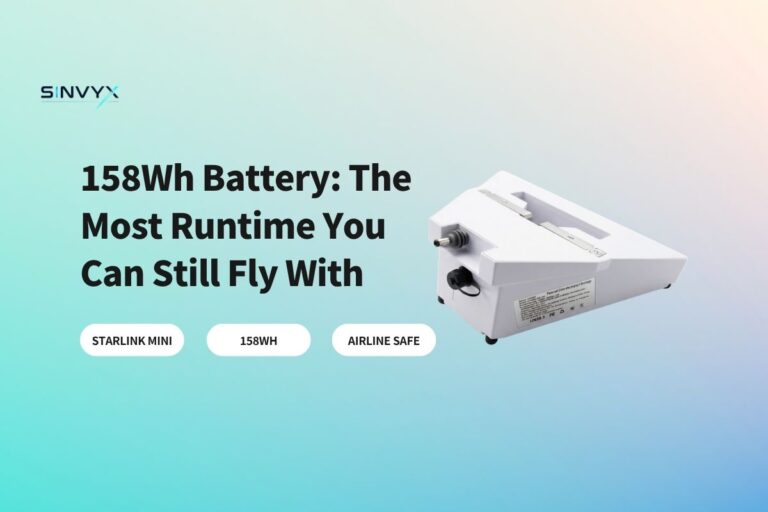
You’re heading somewhere without reliable grid power for two or three days. The 99Wh gets you 3–5 hours per charge — not enough for a full workday of Starlink use. The 180Wh would cover you easily, but it’s restricted from passenger flights. The Starlink Mini 158Wh battery sits in between: 5–7 hours of runtime per charge, still permitted in carry-on baggage with airline approval.
That’s the case for the 158Wh. Here’s everything you need to know before buying.
Why 158Wh Is the Ceiling for Air Travel
Lithium-ion batteries are regulated by watt-hour rating on aircraft. Under IATA and FAA guidelines:
- Under 100Wh — carry-on allowed, no approval needed (that’s the 99Wh model)
- 100–160Wh — carry-on allowed with airline approval, maximum 2 batteries
- Over 160Wh — not permitted on passenger flights (that’s the 180Wh and 200Wh)
At 158Wh, the SINVYX 158Wh battery lands at the top of the approvable range. You get the maximum capacity available for air travel with Starlink Mini.
"Airline approval" sounds more bureaucratic than it is. Most carriers handle it by email or phone before your trip — you provide the watt-hour rating (printed on the battery label), and they confirm it’s permitted. Some airlines approve it on the spot at check-in. The practical rule: contact your airline at least 48 hours before departure, get written confirmation, and keep it on your phone.
Specs
| 158Wh | |
|---|---|
| Capacity | 8.8Ah / 158Wh |
| Output voltage | 15–21V |
| Runtime | 5–7 hours |
| Weight | 2.42 lb / 1.1 kg |
| Charge time | ~5 hours (included charger) |
| Waterproof | IP65 |
| Working temp | -20°C to 60°C |
| Cell brand | EVE (21700 NMC) |
| Cycle life | ≥600 cycles |
| Certifications | UN38.3, MSDS, FCC, UL2743 |
The 158Wh outputs 15–21V directly — the same range Starlink Mini requires. No voltage converters, no adapters, no efficiency losses from conversion.
What to Expect from 5–7 Hours of Runtime
The rated range covers most conditions, but actual runtime depends on how you’re using Starlink Mini:
- Light use (stable connection, moderate signal strength): closer to 7 hours
- Heavy use (continuous video calls, weak signal forcing higher draw): closer to 5 hours
- Cold conditions (-10°C to 0°C): expect 10–15% reduction in runtime; lithium cells lose capacity in cold
If you’re running Starlink Mini for a workday — video calls, file transfers, general connectivity — plan on 5–6 hours per charge. For lighter tasks like email and browsing, you’ll push toward 7.
Two 158Wh batteries (the carry-on maximum with airline approval) give you 10–14 hours total — enough for a long international flight and several hours at your destination before you need to recharge.
Who the 158Wh Is Built For
International travelers who need more than a half-day of connectivity. The 99Wh covers short trips or backup use. The 158Wh handles a full workday, with enough left over for the evening.
Remote workers on the move. At 5–7 hours per charge, you get through a standard workday on one battery with no outlet required. Two batteries extends that to 10–14 hours — a full day of meetings without hunting for power.
Overlanders and campers flying to a trailhead. If you’re flying to a remote destination and setting up Starlink Mini for 2–3 days, the 158Wh gives you meaningful runtime without the shipping restrictions of the 180Wh and 200Wh models.
The 158Wh doesn’t make sense for everyone. If you’re mostly stationary — a vehicle with battery power, a fixed camp, or a home base — the 180Wh or 200Wh give you more runtime without the airline-approval step. If you rarely need more than a few hours at a time, the 99Wh is lighter and clears TSA without any paperwork.
Solar Charging
The 158Wh accepts solar input up to 100W at 20–40V PV. If you’re at a remote location for multiple days, pairing it with a compatible folding solar panel lets you recharge during daylight hours and run Starlink Mini through the evening.
A 60W panel in good sunlight will recharge the 158Wh in roughly 3–4 hours. Actual charge time varies with panel output and conditions.
IP65 and Temperature Range
IP65 (dustproof and water-resistant to direct spray) means the 158Wh handles rain, splashing water, and dusty environments without issue. It won’t survive submersion, but it holds up in the conditions where you’d actually be using Starlink Mini outdoors.
The -20°C to 60°C working temperature range covers most outdoor use cases, from winter camping to desert environments. Cold temperatures reduce capacity somewhat, but the battery keeps working where many alternatives don’t.
158Wh vs. 99Wh vs. 180Wh: Quick Comparison
| 99Wh | 158Wh | 180Wh | |
|---|---|---|---|
| Runtime | 3–5 hr | 5–7 hr | 6–9 hr |
| Weight | 1.7 lb | 2.42 lb | 2.42 lb |
| Airline | ✅ No approval needed | ✅ Needs approval | ❌ Not permitted |
| Best for | Travel, day trips | Multi-day travel, remote work | Overlanding, marine, stationary |
Going from 99Wh to 158Wh adds roughly 2 hours of runtime and 0.72 lbs. Going from 158Wh to 180Wh adds 1–2 more hours but removes the option to fly with it. If you need to get on a plane and you need a full workday of runtime, 158Wh is the answer.
FAQ
How do I get airline approval for the 158Wh battery?
Contact your airline directly — most have a customer service line or online form for battery approval requests. Have the watt-hour rating ready (158Wh, printed on the battery label). Most carriers respond within 24–48 hours. Get written confirmation and keep it accessible when you travel.
Can I bring two 158Wh batteries on a plane?
Yes. IATA guidelines allow up to two spare lithium-ion batteries in the 100–160Wh range in carry-on baggage, with airline approval. Both must go in carry-on — not checked luggage.
What cells does the 158Wh use?
EVE 21700 NMC cells — a different cell brand from the 99Wh, 180Wh, and 200Wh models, which use Samsung or LG cells. EVE is a well-established manufacturer with a strong track record in energy storage. The 158Wh still carries ≥600 cycle life, matching the rest of the lineup.
Is the 158Wh enough for overnight use?
Not on a single charge. At 5–7 hours per charge, it’s built for daytime use. Two batteries in carry-on give you 10–14 hours total. For true overnight or multi-day coverage from a single unit, look at the 180Wh or 200Wh models (sea or ground freight only).
What’s the difference between 158Wh and 160Wh?
Both sit in the same regulatory category (100–160Wh). The 158Wh rating gives a small buffer below the 160Wh ceiling. There’s no meaningful difference in how airlines treat them — both require pre-approval in the same category.
Have a specific route or setup in mind? We can help you figure out which capacity fits your trip — just reach out.