The short answer: A 200Wh battery can run Starlink Mini for roughly 5 to 8.5 hours, depending on how you use it.
That’s a wide range — and for good reason. Starlink Mini’s power draw shifts a lot based on what you’re doing. Stream a 4K video and you’re pulling close to 30W. Leave it idle on a clear-sky day, and recent firmware updates have pushed that number down to 16–20W.
Here’s the math, and more importantly, what it means for real trips.
What Starlink Mini Actually Draws (Updated for 2026)
Starlink Mini’s official specs list typical use at 30–35W, peak at 40W. But the January 2026 firmware update changed things significantly. Real-world measurements now show:
| Usage Type | Power Draw |
|---|---|
| Idle / standby | 12–16W |
| Light browsing | 16–20W |
| Video calls / streaming | 28–35W |
| Boot-up | 36–40W (short burst) |
| Cold start surge | up to 100W (instantaneous, settles in seconds) |
The firmware update cut steady-state power by roughly 25%. If you bought your Starlink Mini before 2026 and are working off old numbers, your real runtime is probably better than you think.
The Runtime Calculation
A 200Wh battery doesn’t deliver a full 200Wh to your device. Energy is lost in the conversion process — typically around 85% efficiency for a quality battery with a direct DC output.
Usable energy: 200Wh × 85% = ~170Wh
| Usage Scenario | Power Draw | Estimated Runtime |
|---|---|---|
| Idle / very light use | 20W | ~8.5 hours |
| Normal browsing | 25W | ~6.8 hours |
| Video streaming | 30W | ~5.7 hours |
| Heavy use (calls + uploads) | 35W | ~4.9 hours |
So for a full day of moderate outdoor use — some browsing, occasional video calls, mixed in with idle time — you’re comfortably looking at 6 to 7 hours from a 200Wh battery.
What This Looks Like on an Actual Trip
Scenario 1: Remote work day from a campsite
You’re video calling for 2 hours, browsing for 4 hours, idle the rest. Average draw: ~24W. Runtime: ~7 hours. Covers a full workday without recharging.
Scenario 2: Weekend camping, occasional use
Checking maps, sending messages, streaming an hour of video at night. Average draw: ~20W. Runtime: 8+ hours. Probably enough to stretch across two days with light use.
Scenario 3: Van life, heavy streaming
Running Netflix or YouTube most of the evening. Average draw: ~32W. Runtime: ~5.3 hours. You’ll want a solar panel to top it up during the day.
Why 200Wh Hits the Sweet Spot
Go smaller — say, 99Wh — and you’re looking at 3–5 hours. Enough for a day hike but tight for overnight use. Go bigger, and you start running into airline restrictions (batteries above 160Wh require airline approval; above 300Wh are generally prohibited).
200Wh is the largest battery you can reasonably travel with. It’s not airline-carry-on-friendly without approval, but it covers the use cases that matter: camping, overland trips, van setups, emergency backup.
Tips to Get More Hours Out of Your Battery
1. Use DC output, not AC inverter
Inverting to AC and back to DC wastes 10–20% of your energy. If your battery has a direct DC output matched to Starlink Mini’s input voltage (15–21V), use it.
2. Let the Mini warm up before heavy use
The boot-up surge (up to 100W for a few seconds) is unavoidable, but it’s brief. Don’t worry about it — it’s not a sustained draw.
3. Point the dish properly
A dish struggling to maintain signal draws more power. A clear sky lock at the right angle pulls less.
4. Turn it off when you don’t need it
Obvious, but worth saying: Starlink Mini at idle still draws 12–16W. Over 8 hours, that’s nearly 100Wh — half your battery — doing nothing useful.
5. Add a solar panel for longer trips
A 60–100W panel can fully offset Starlink Mini’s typical draw in good sun. Pair it with a 200Wh battery and you’re running indefinitely during daylight.
The SINVYX 200Wh Option
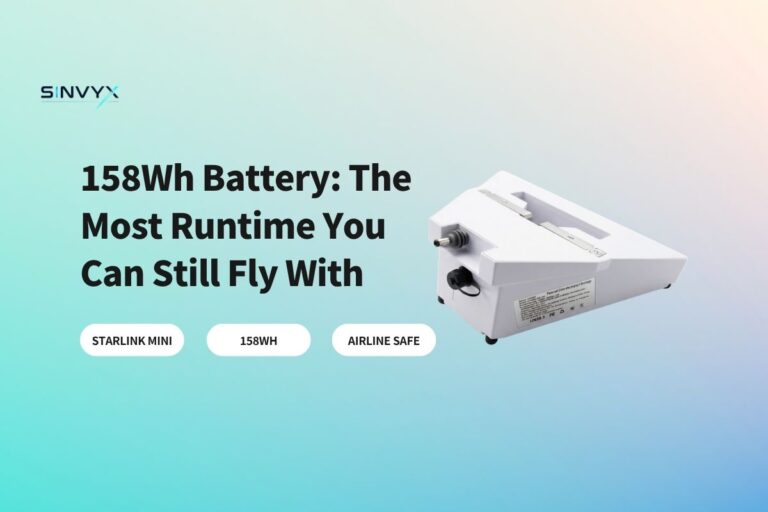
The SINVYX 200Wh battery was built specifically for Starlink Mini. It outputs 15–21V DC directly — no inverter needed, no efficiency loss from AC conversion. That’s how it achieves 7–10 hours of real-world runtime based on specs and user reports.
A few specs worth knowing:
- Capacity: 200Wh / 11Ah
- Output: 15–21V DC (direct Starlink Mini compatible)
- Weight: 2.42 lb / 1.1 kg
- Solar input: up to 100W (20–40V)
- Operating temp: -20°C to 60°C
- Waterproofing: IP65
- Cell brand: Samsung / LG
- Cycle life: 600+ charges
The IP65 rating means it handles rain, dust, and the general chaos of outdoor use. The -20°C lower limit means it works in winter camping conditions where most consumer batteries start to fail.
It’s not the cheapest option. But it’s one of the few batteries designed around what Starlink Mini actually needs, rather than a general-purpose power station you’re adapting for the job.
Bottom Line
A 200Wh battery gives you a genuine full day with Starlink Mini — longer if you’re conservative with use, shorter if you’re streaming heavily. For most outdoor use cases, it’s the right size: enough capacity to matter, light enough to carry, within reach of practical solar charging.
If you’re building a Starlink Mini setup for camping, van life, or remote work, 200Wh is the number to plan around.
SINVYX builds batteries specifically for Starlink Mini. See the 200Wh battery →