Since the launch of the Starlink Mini, high-speed satellite internet on the go has become a reality. Whether you’re a pilot soaring through the clouds, an explorer venturing into the wilderness, or a digital nomad chasing ultimate freedom, the Starlink Mini opens up a world of connectivity. But to keep this revolutionary device running, a reliable portable power source is essential.
The market is flooded with power banks, from pocket-sized chargers to thousand-watt-hour (Wh) power monsters. However, for many users, a lightweight battery under 160Wh strikes the perfect balance of portability, regulatory compliance, and practicality. This guide will take you deep into the sub-160Wh Starlink Mini battery market, helping you find the perfect match for any scenario.
Understanding Your Starlink Mini’s Appetite: A Quick Power Guide
Before choosing a battery, you need to understand the Starlink Mini’s basic power requirements. This explains why your average phone power bank won’t cut it.
- Power Consumption: The Starlink Mini’s power draw varies. It idles at around 20W, consumes 35-40W during standard use, and can spike to 60W under heavy load, like when searching for satellites [1].
- Startup Requirement: This is the most critical factor. Official Starlink Mini specs state that if you’re using USB-C Power Delivery (PD), the power source must deliver at least 100W to ensure a successful boot-up [2]. For DC power, a stable 12V-48V output is required.
This means you don’t just need a high-capacity battery; you need a professional-grade power source with sufficient output.
A Must-Read for Fliers: Latest Airline Battery Regulations (2026 Standards)
Before we dive into comparisons, let’s cover the latest airline regulations. According to the latest 2026 standards from aviation authorities like the FAA and IATA, there are strict limits on carrying lithium batteries on board:
| Watt-hour (Wh) Range | Carry-On Allowed? | Requirements |
|---|---|---|
| Under 100Wh | ✅ Yes | Carry-on only. No airline approval needed. Quantity is typically unlimited for personal use. |
| 100Wh – 160Wh | ⚠️ Restricted | Airline approval is required. Carry-on only. Limit of 2 spare batteries per person. |
| Over 160Wh | ❌ Forbidden | Strictly prohibited in both carry-on and checked baggage. |
This rule is crucial as it directly impacts your choices for air travel. A 99Wh battery is the top choice for hassle-free flying, while a 158Wh battery falls into the restricted category—permissible, but requires extra steps.
Lightweight Champions: 95Wh vs. 99Wh vs. 145Wh vs. 158Wh
The sub-160Wh market is a battleground of four key capacities: 95Wh, 99Wh, 145Wh, and 158Wh. Each represents a different balance of power, portability, and features.
At-a-Glance Spec Comparison
Here’s a quick look at some of the most popular models on the market.
| Specification | 95Wh Standard (MSAFF) | 99Wh (LifePO4 Powers) | 99Wh (Ennzia E100) | 99Wh (PeakDo LinkPower) | 99Wh (Flight Gear Max) | 145Wh (AMPak 145) | 158Wh (LifePO4 Powers) |
|---|---|---|---|---|---|---|---|
| Capacity | 95Wh | 99Wh | 99Wh | 99Wh (27,600mAh) | ~97Wh (27,600mAh) | 145Wh | 158Wh |
| Rated Runtime | 3-4 Hours | 3-5 Hours | ~5 Hours | 3-4 Hours | 2-3 Hours | ~7 Hours (@20W) | 5-7 Hours |
| Weight | ~1.87 lbs / 0.85kg | 1.7 lbs / 0.79kg | Lightweight | Lightweight | <1.5 lbs / 0.7kg | ~1.9 lbs / 0.86kg | 2.42 lbs / 1.1kg |
| Airline Carry-On | ❌ | ✅ No Approval Needed | ✅ No Approval Needed | ✅ No Approval Needed | ✅ No Approval Needed | ⚠️ Approval Required | ⚠️ Approval Required |
| Waterproof Rating | Basic | IP65 | IP65 | IPX4 | Basic | Basic | IP65 |
| Key Feature | Budget-Friendly | Quick-Release, Auto-Sleep | High Waterproofing | LCD Screen, Pass-Through | Color Screen, 140W Output | Integrated Stand | Clip-On Design, Solar Charging |
| Price (Approx.) | ~$120 | $149.99 | ~$180 | ~$190 | ~$180 | ~$200 | $199.00 |
Source: [3] [4] [5] [6] [7] [8]
1. The 95Wh Class: The Budget-Friendly Starter
The MSAFF 95Wh is the most economical entry point. It delivers about 3-4 hours of real-world runtime, enough for short trips or emergencies. A Reddit user reported their 95Wh battery powered a Starlink Mini for 223 minutes (3 hours, 43 minutes) [9]. If you’re on a tight budget and don’t need all-day power, it’s a solid start.
User Quote: "For occasional outdoor use, 95Wh is plenty. It’s light, cheap, and perfect for an emergency kit."
2. The 99Wh Class: The Perfect Balance of Power and Portability
99Wh is the "golden capacity" because it sits just under the 100Wh no-approval limit for flights, making it the #1 choice for pilots and frequent flyers [2]. Competition here is fierce, and brands are packing in features.
LifePO4 Powers 99Wh: Aviation-Grade Design & Quick-Release
The LifePO4 Powers 99Wh is an aviation-grade battery built specifically for the Starlink Mini. It features a rugged PC+ASA automotive-grade housing for superior durability. Its standout feature is a quick-release buckle system that replaces the original kickstand, allowing for tool-free installation. The battery provides 3-5 hours of runtime, weighs only 1.7 lbs (0.79kg), and includes an IP65-rated output port, an LED power indicator, and an intelligent auto-sleep function that shuts down after 2 minutes of inactivity to save power [8].
At $149.99, it’s competitively priced against other 99Wh options.
Key Advantages: Airline-safe (no approval), quick-release design, IP65 waterproof, smart power management, great value.
Other 99Wh Contenders
- Ennzia E100: Its main selling point is its IP65 waterproof and dustproof rating, making it a reliable choice for harsh outdoor conditions [4].
- PeakDo LinkPower: This model is feature-rich, with an LCD screen for detailed status and pass-through charging (use while charging), a huge convenience [5].
- Flight Gear Smart Battery Pack Max: Designed for aviation, this battery boasts a powerful 140W output to guarantee a stable Starlink Mini startup. Its color screen displays temperature, time remaining, and other vitals, making it the most advanced 99Wh option [2].
3. The 145Wh Class: The Performance Choice for Longer Runtimes
If you don’t mind getting airline approval and need more power, the AMPak 145 by Devos Outdoor is an excellent choice. It delivers up to 7 hours of runtime at a 20W draw, enough for a full workday. Its unique integrated 8° stand provides a stable base for your Starlink Mini without extra gear [6].
User Quote: "The integrated stand on the AMPak 145 is brilliant. It saves me from carrying a separate tripod, and the 7-hour runtime gives me peace of mind to work outdoors all day."
4. The 158Wh Class: The Endurance Flagship
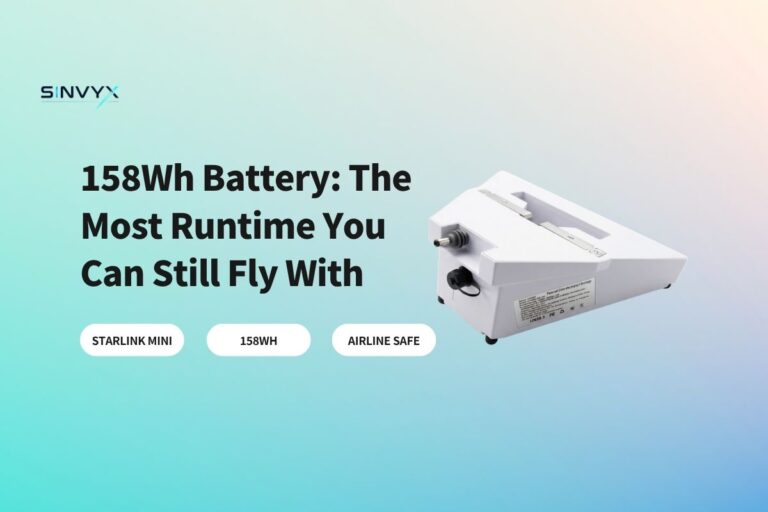
The LifePO4 Powers 158Wh battery is one of the largest-capacity options under 160Wh, delivering an impressive 5-7 hours of runtime. It uses LiFePO4 chemistry, giving it a much longer lifespan of over 3,000+ charge cycles compared to standard lithium-ion batteries [7].
Its unique clip-on design secures it firmly to the Starlink Mini. It also supports solar charging (up to 100W), making it perfect for long-term off-grid work or expeditions. Other features include an IP65 waterproof rating, a 4-level LED indicator, and pass-through charging.
At $199.00, it costs just a penny less than the AMPak 145 but offers more capacity and features.
Tech Highlights:
- Capacity: 158Wh
- Runtime: 5-7 Hours
- Recharge Time: 3-4 Hours (with recommended charger)
- Solar Input: ≤100W (20-40V)
- Operating Temperature: -4°F to 140°F (-20°C to 60°C)
- Cycle Life: 3,000+
Key Advantages: Longest runtime, solar charging, LiFePO4 longevity, IP65 waterproof, pass-through charging, competitive price.
Scenario-Based Buyer’s Guide: Which Battery is Your Co-Pilot?
With so many great options, which one should you choose? Let’s match the best battery to your lifestyle.
Scenario 1: Pilots & Frequent Fliers
-
Top Pick (No Approval Needed): LifePO4 Powers 99Wh or Flight Gear Smart Battery Pack Max (99Wh)
- Why: The LifePO4 Powers 99Wh offers the best blend of convenience and compliance with its aviation-grade design, quick-release mount, and great price ($149.99). The Flight Gear Max is for users who want maximum power (140W output) and detailed monitoring on its color screen.
-
Backup Option (Airline Approval Required): LifePO4 Powers 158Wh or AMPak 145
- Why: If you need nearly double the runtime and are willing to get airline approval, these larger batteries are a viable option. They are less portable and require extra paperwork but deliver extended power.
Scenario 2: Outdoor Camping & Backpacking
- Performance Pick: LifePO4 Powers 158Wh
- Why: With up to 7 hours of runtime and solar charging, it’s the perfect companion for extended outdoor adventures. Pass-through charging ensures you’re never offline.
- Runner-Up: AMPak 145
- Why: The integrated stand and 7-hour runtime are excellent for campers.
- Waterproof Pick: Ennzia E100 (99Wh)
- Why: Its IP65 rating can handle any weather, and its light weight is ideal for hiking.
Scenario 3: Digital Nomads & Remote Workers
- Feature Pick: PeakDo LinkPower (99Wh) or LifePO4 Powers 158Wh
- PeakDo LinkPower: Pass-through charging is a killer feature for working from cafes or co-working spaces. The LCD screen makes power management easy.
- LifePO4 Powers 158Wh: 5-7 hours of runtime, solar input, and pass-through charging cover all your needs for a full day of remote work.
Scenario 4: Short Trips & Emergency Backup
- Budget Pick: 95Wh Standard Model
- Why: It’s the cheapest and lightest option, providing 3-4 hours of power for quick tasks or emergencies.
- Balanced Pick: LifePO4 Powers 99Wh
- Why: It’s airline-safe, lightweight, has a quick-release mount, and is affordably priced, making it ideal for short trips.
Deep Dive: The LifePO4 Powers Advantage
As your partner, LifePO4 Powers offers two professional-grade batteries for the Starlink Mini that deserve a closer look.
LifePO4 Powers 99Wh: The Perfect Travel Companion
This battery is engineered for travelers, fully complying with the FAA & TSA’s 100Wh no-approval-needed limit. Its quick-release buckle system replaces the factory kickstand, allowing for a 30-second, tool-free installation. The PC+ASA automotive-grade housing is UV-resistant, flame-retardant, and impact-resistant, ensuring durability in any environment.
- Smart Power Management: A short press checks the power level, a 3-second long press turns it on/off, and it automatically sleeps after 2 minutes of inactivity. These details drastically reduce self-discharge.
- IP65 Waterproofing: With silicone seals and a protective cap, it’s built to withstand the elements.
- Unbeatable Value: At $149.99, it offers the best bang for your buck in the 99Wh category.
LifePO4 Powers 158Wh: The Ultimate Off-Grid Workhorse
If you need maximum runtime and flexibility, the 158Wh is your answer. It delivers 5-7 hours of power, enough to cover most of a workday.
- LiFePO4 Technology: Compared to standard lithium-ion, LiFePO4 offers superior thermal stability, a much longer cycle life (3,000+), and enhanced safety. Your investment lasts longer.
- Solar Charging: It supports up to 100W of solar input, perfect for long-term remote work. Pair it with a compatible solar panel for complete energy independence.
- Pass-Through Charging: Power your Starlink Mini while the battery recharges, ensuring zero downtime.
- Price & Value: While the $199.00 price is higher, it offers more capacity, a longer runtime, and solar capability than the similarly priced AMPak 145.
Frequently Asked Questions (FAQ)
Q1: Can I use a regular phone power bank for my Starlink Mini?
A: No. Standard power banks cannot supply the 100W output or stable high-voltage DC power required to boot the Starlink Mini, leading to startup failures.
Q2: What is "pass-through charging" and is it important?
A: It allows the battery to power a device while it is also being charged. This is a critical feature for users who need uninterrupted Starlink connectivity. The LifePO4 Powers 158Wh and PeakDo LinkPower both support this.
Q3: Are these batteries safe?
A: Yes. The brands featured here are certified (UN38.3, CE, FCC) and include multiple safety protections like over-temperature, overload, and short-circuit protection. The LifePO4 Powers products use LiFePO4 chemistry, known for its superior thermal stability.
Q4: What’s the difference between the LifePO4 Powers 99Wh and 158Wh?
A: The main differences are capacity, runtime, and airline regulations. The 99Wh provides 3-5 hours of runtime and is carry-on safe without airline approval, making it the top choice for air travel. The 158Wh offers 5-7 hours of runtime but requires airline approval to fly, making it better for non-air travel or for those willing to get approval. The 158Wh also supports solar charging.
Q5: Is solar charging actually useful?
A: Absolutely, especially for long-term remote work or expeditions. The LifePO4 Powers 158Wh supports up to 100W of solar input, allowing you to stay powered up indefinitely with a compatible solar panel.
Conclusion: Your Choice, Your Freedom
Choosing a Starlink Mini battery is about more than just capacity; it’s about choosing your lifestyle. The sub-160Wh market offers a fantastic range of options, from ultra-portable to ultra-long-lasting. There’s a perfect battery out there for your unique needs.
Quick Decision Guide:
- For frequent fliers: Get the LifePO4 Powers 99Wh (no approval, great value) or get approval for the LifePO4 Powers 158Wh for longer trips.
- For the longest runtime & solar: Choose the LifePO4 Powers 158Wh.
- For features like pass-through charging: Pick the PeakDo LinkPower or LifePO4 Powers 158Wh.
- For campers who want an integrated stand: The AMPak 145 is for you.
- On a tight budget: Start with a 95Wh standard model or the LifePO4 Powers 99Wh.
We hope this guide helps you stay connected and powered up on your adventures. No matter which you choose, you’re investing in your freedom and connectivity.
References
[1] Starlink Mini Power Consumption Analysis, Reddit r/Starlink, 2024.
[2] "The perfect portable battery for Starlink: Flight Gear Smart Battery Pack Max," iPad Pilot News, July 29, 2025.
[3] "MSAFF Starlink Mini Battery Pack 95Wh," Amazon Product Page, 2025.
[4] "Ennzia E100 Starlink Mini Battery Pack with Charger, 99Wh," Ennzia Official Website, 2025.
[5] "PeakDo LinkPower Power Bank Compatible with Starlink Mini," PeakDo Official Website, 2025.
[6] "AMPak 145 Portable Battery for the Starlink Mini," Devos Outdoor, 2025.
[7] "LifePO4 Powers 158Wh Battery for Starlink Mini," LifePO4 Powers Official Website, 2026.
[8] "LifePO4 Powers 99Wh Starlink Mini Battery," LifePO4 Powers Official Website, 2026.
[9] "Observations running Starlink Mini on battery power," Reddit r/Starlink, August 9, 2024.